LEGGIC FIT
7/8 vs Full-Length vs Capri Leggings
Full-length leggings aim near the ankle, 7/8 leggings finish above it, and capris finish farther up the lower leg. The labels are not standardized, so your own preferred inseam is a better baseline than height alone.
Reviewed 2026-09-15
Full-length leggings aim near the ankle, 7/8 leggings finish above it, and capris finish farther up the lower leg. The labels are not standardized, so your own preferred inseam is a better baseline than height alone.
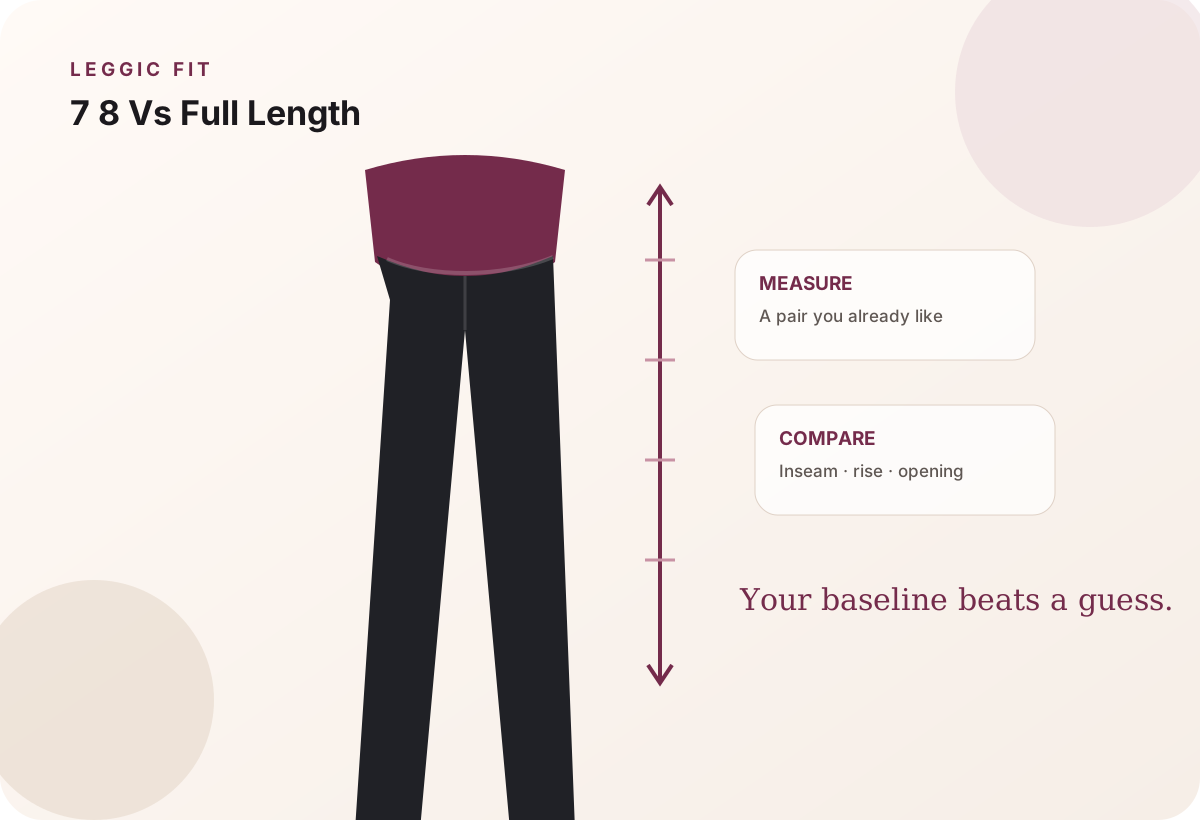
What matters
- Measure a pair whose hem position you already like before comparing retail labels.
- Treat 7/8, ankle, cropped and capri as position descriptions, not universal inseam numbers.
- If you want the new hem a specific distance above your current one, subtract roughly that distance from your preferred inseam as a starting point.
- Check ankle or calf opening as well as inseam because a shorter hem lands on a wider part of the leg.
Quick comparison: full length, 7/8 and capri
- Full length: intended to finish around the ankle area, with exact coverage depending on body proportions and brand pattern.
- 7/8 length: intended to show some ankle and sit visibly above a full-length hem.
- Capri / three-quarter: intended to finish around the lower knee to mid-calf region depending on the design.
- Ankle length and cropped are retailer terms that can overlap with these categories, so the listed inseam matters more than the label.
Use your own pair as the baseline
Lay a pair that already ends exactly where you want on a flat surface and measure from the crotch seam to the hem without stretching it. Record that number and the actual hem position on your body.
If you want another pair to finish two inches higher, a garment about two inches shorter is a rational first comparison. It is still only a starting point because a different rise, fabric stretch or leg opening can change where the hem settles.
Why height charts are only rough context
Two people with the same total height can have different leg-to-torso proportions, and brands do not use one universal definition of 7/8 or full length. A personal garment measurement therefore transfers better than a generic rule such as “this inseam is for everyone under a certain height”.
Length changes more than appearance
- A shorter hem lands on a wider part of the calf, so the opening can feel tighter even when the main size is unchanged.
- Extra full-length fabric may bunch at the ankle or inside boots.
- For flared leggings, footwear height changes the correct finished length and floor clearance.
- For stirrup or footed leggings, vertical tension is anchored under or around the foot, so ordinary cropped-length rules do not apply.
- If a pair slides down or pulls at the crotch, do not assume inseam alone is responsible; rise and waistband anchoring may be the real cause.
Quick FAQ
- Is 7/8 always a fixed number of inches shorter than full length? No. It describes a target proportion/hem position, and brands use different patterns.
- Can petite shoppers use 7/8 as full length? Sometimes, but measure the actual inseam instead of assuming it will happen automatically.
- Is capri the same as 7/8? Usually not; capri ends higher on the lower leg, but retailer naming can overlap.
- Should tall shoppers avoid 7/8? No. Choose it if you want an above-ankle hem; just check the actual inseam so the crop looks intentional.
Use this in practice
Compare the garment information you can verify — measurements, construction, care label and composition — with the way the pair actually behaves on your body. Avoid treating a single marketing term as a guarantee.